
BookableFree cancellation
Warsaw Food Tasting Tour with Delicious Poland
4.8(299)
Ratings collected by Viator + Tripadvisor
From $107.752 hr 30 min
View experience
Compare full details and current availability before you choose.
Cookie preferences
Natifly uses necessary browser storage for core features such as sign-in, security, private account workflows, and remembering this choice. Optional Google Analytics cookies are used only if you allow analytics.
Supports essential site, security, account, booking, and consent-preference functions. These are not switched on or off by the analytics choice.
Measures sanitized page categories and a small allowlist of product interactions. The Google Analytics tag stays blocked until you allow analytics.
Google advertising consent signals remain denied by this control. Analytics does not determine qualified creator views or creator earnings. Read the Cookie Notice and Privacy Notice.

Poland
Image: Marek Bednarz · CC BY-SA 3.0 pl · Wikimedia Commons · Source
Plan your travel
Keep destinations you are considering together in a private trip.
City overview
Warsaw is a city of reconstruction, layered memory and fast-changing neighborhoods. The rebuilt Old Town offers the historic visual anchor, while POLIN Museum, the former Jewish district, Praga and the broad parks of Łazienki reveal deeper stories about the city's past and present. A first visit is strongest when travelers move beyond the postcard center and allow time for museums that explain how dramatically Warsaw has changed.
Best time to visit
Late spring through early autumn offers long walking days. Winter is cold and can be snowy, while major historical museums remain worthwhile year-round.
Currency
PLN
Language
Polish; English is common in major visitor areas
Bookable experiences
Compare tours, tickets, and activities by photos, ratings, starting prices, duration, cancellation details, and available options before choosing what fits your trip.
Ratings collected by Viator + Tripadvisor
Compare full details and current availability before you choose.

Ratings collected by Viator + Tripadvisor
Compare full details and current availability before you choose.
Ratings collected by Viator + Tripadvisor
Compare full details and current availability before you choose.

Ratings collected by Viator + Tripadvisor
Compare full details and current availability before you choose.

Ratings collected by Viator + Tripadvisor
Compare full details and current availability before you choose.

Ratings collected by Viator + Tripadvisor
Compare full details and current availability before you choose.
See and do
Explore landmarks, museums, viewpoints, markets, parks, and cultural sites. Open any place for practical visit context, nearby experiences, traveler Journeys, flight planning, and Add to Trip.
Food Hall & Dining
Hala Koszyki is a restored market hall with restaurants, bars and food counters in central Warsaw. It works as a convenient evening stop after museum-heavy sightseeing, though travelers should also explore smaller neighborhood cafés beyond the hall.
Image: Marek Bednarz · CC BY-SA 3.0 pl · Wikimedia Commons · Source
View attraction →Museum & History
POLIN Museum presents a broad history of Jewish life in Poland across centuries rather than focusing only on the Holocaust. Its extensive galleries deserve several hours and provide essential context for Warsaw's former Jewish district and memorial landscape.
Image: Marek Bednarz · CC BY-SA 3.0 pl · Wikimedia Commons · Source
View attraction →Neighborhood & Culture
Praga on the east bank of the Vistula retains prewar streets, courtyards and industrial buildings alongside newer cultural venues. Explore with awareness that it is a lived-in district, and focus on established public streets rather than private courtyards.
Image: Marek Bednarz · CC BY-SA 3.0 pl · Wikimedia Commons · Source
View attraction →Historic Center & Heritage
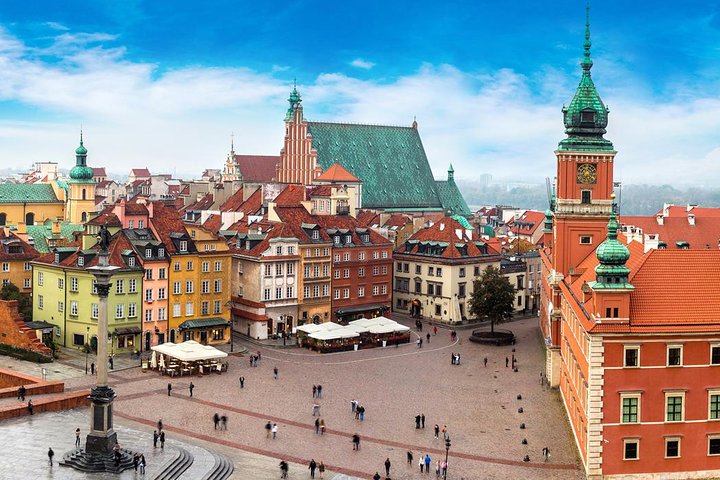
Warsaw's Old Town was painstakingly reconstructed after wartime destruction and now forms the city's most recognizable historic core. Walking from Castle Square through the market square is more meaningful when paired with context about the reconstruction process.
Image: Marek Bednarz · CC BY-SA 3.0 pl · Wikimedia Commons · Source
View attraction →Park & Gardens
Łazienki Park is Warsaw's grandest green space, with landscaped paths, ponds, classical pavilions and the Palace on the Isle. It is large enough for a relaxed half day and offers a quieter contrast to the city's dense historical museums.
Image: Marek Bednarz · CC BY-SA 3.0 pl · Wikimedia Commons · Source
View attraction →Practical planning
Planning
Three days is a good minimum for Old Town, major history museums, Łazienki Park and at least one neighborhood beyond the center. Keep arrival day lighter than the rest of the trip so transport delays, weather and check-in do not disrupt a must-see reservation.
Culture
Many sites deal with war, occupation and loss; keep behavior and photography respectful in memorial spaces and museum settings.
Money
Poland uses the złoty. Cards are widely accepted, while cash remains useful at smaller businesses and markets.
Planning
Give POLIN or another major history museum enough time rather than stacking several in one day. Pair Old Town with the riverfront and Praga separately. Major museums and observation experiences can be busy on weekends, so reserve a must-see museum slot if your itinerary is tight.
Transport
Metro, trams and buses cover the city efficiently. Distances can be larger than they appear, so use transit between Old Town, Praga and southern districts.
Common questions
Major museums and observation experiences can be busy on weekends, so reserve a must-see museum slot if your itinerary is tight.
Poland uses the złoty. Cards are widely accepted, while cash remains useful at smaller businesses and markets.
Three days is a good minimum for Old Town, major history museums, Łazienki Park and at least one neighborhood beyond the center.
Metro, trams and buses cover the city efficiently. Distances can be larger than they appear, so use transit between Old Town, Praga and southern districts.
Late spring through early autumn offers long walking days. Winter is cold and can be snowy, while major historical museums remain worthwhile year-round.